



Go Back
PRESS RELEASES
National Museum Of Racing and Hall of Fame to enshrine late trainer John Shirreffs, plus Santa Anita thoroughbred stars Kona Gold and Gulch Friday in Saratoga Springs, N.Y.
8/5/2026
NATIONAL MUSEUM OF RACING AND HALL OF FAME TO ENSHRINE LATE TRAINER JOHN SHIRREFFS, PLUS SANTA ANITA THOROUGHBRED STARS KONA GOLD AND GULCH FRIDAY IN SARATOGA SPRINGS, N.Y.
ARCADIA, CA (Aug. 5, 2026)—Former Santa Anita Thoroughbred stars Kona Gold and Gulch and renowned trainer John Shirreffs, who spent his career in Southern California, will all be enshrined this Friday in the National Museum of Racing and Hall Fame in Saratoga Springs, N.Y. The induction ceremony for this year’s full Hall of Fame class begins at 10:30 a.m. ET in the Humphrey S. Finney Sales Pavillion near historic Saratoga Race Course. Free and open to the public, the ceremony will also be streamed live at racingmuseum.org.
Shirreffs’ entry into the Hall of Fame comes posthumously. In February, just two weeks before his induction was announced, Shirreffs died unexpectedly at his home in Arcadia near Santa Anita Park. He was 80.
Shirreffs was a master of his craft who was revered for the patience and individualized attention he provided his horses. A native of Fort Leavenworth, Kan., and former U.S. Marine who served in the Vietnam War, Shirreffs saddled 596 winners and tallied more than $58 million in purses during a career that began in the 1970s.
Accepting the Hall of Fame plaque on Shirreffs’ behalf will be his wife of 23 years, Dottie Ingordo-Shirreffs.
“This would mean the world to John. He truly treasured the history of the sport,” Ingordo-Shirreffs said. “His library was filled with old horse racing books. He particularly loved Man o’ War. To be put in with the all-time greats, it truly would have meant the world to him.”
After first rising to national prominence in the 1990s, Shirreffs’ stable reached its pinnacle in the decade that followed. First, in 2005, Shirreffs completed a lifelong dream when winning the Kentucky Derby with Santa Anita-based Giacomo, a 50-1 longshot ridden by Hall of Fame jockey Mike Smith. Two years later, a new stable star for Shirreffs began to emerge by the name of Zenyatta.

With Shirreffs at the controls, Zenyatta won the first 19 races of her remarkable career. In 2008, she capped off the season by beating the world’s best female horses in the Breeders’ Cup Ladies’ Classic held at Santa Anita. Then the following year, also at Santa Anita, Zenyatta achieved racing immortality when becoming the first and still only female horse to win the Breeders’ Cup Classic. Her incredible run of success garnered national headlines and created legions of adoring fans.
“He called it Camelot, those years,” Ingordo-Shirreffs said. “John knew she was special and wanted to share her with the world.”
Zenyatta’s only loss came in in her final career start when making a title defense in the 2010 Breeders’ Cup Classic, this time at Churchill Downs. Under the famed Twin Spires, Zenyatta unleashed her patented late rally but came up agonizingly short when losing by a head.
Zenyatta was inducted into the Racing Hall of Fame in 2016. Both Zenyatta and Giacomo were owned by Jerry Moss, the co-founder of A&M Records, along with his then-wife Ann Moss. While Jerry Moss died in 2023 at the age of 88, Ingordo-Shirreffs said Ann will be in attendance for Friday’s Hall of Fame ceremony.
“I’m just so proud of him,” Ingordo-Shirreffs said. “He worked so hard and absolutely loved the horses. His passion for the Thoroughbred was beyond words.”

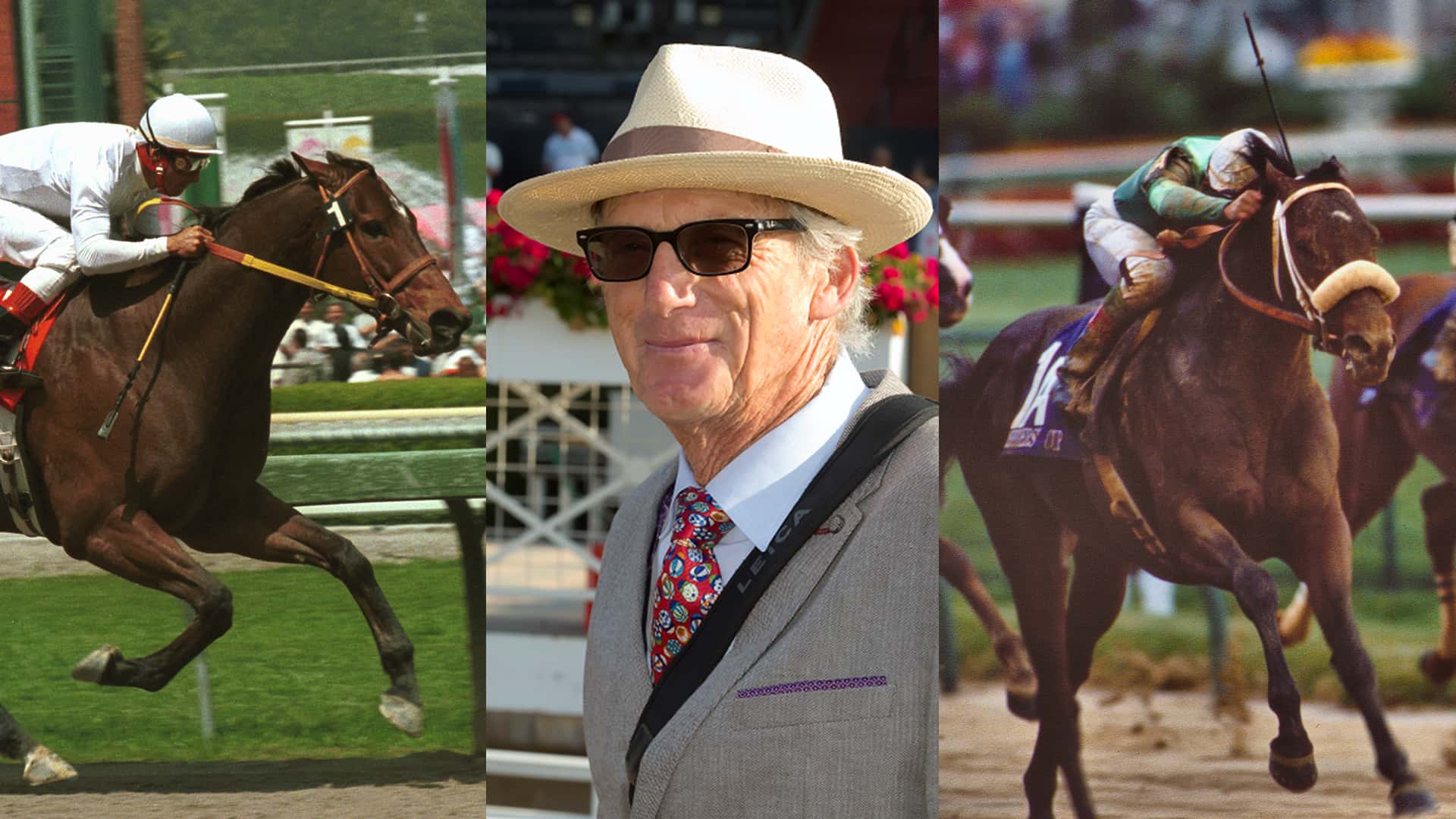
KONA GOLD Benoit Photo
KONA GOLD
The brilliant sprinter Kona Gold displayed his excellence for five-plus seasons from 1998-2003. Trained by the late Bruce Headley, who also co-owned the speedy gelding, Kona Gold won 14 of 30 starts including 12 stakes—seven of which came at Santa Anita Park. Purchased by Headley for $35,000 as a yearling, the son of Java Gold would go on to bank nearly $2.3 million in purse earnings for Headley and co-owners Irwin Molasky, Andrew Molasky and Michael Singh.
Among those who worked closely with Kona Gold during his racing days was Karen Headley, Bruce Headley’s daughter who is now an active trainer in her own right. Bruce Headley died in 2021 at the age of 86.
“My father always knew he was a Hall of Fame horse,” said Karen upon learning of the induction. “It seems like he knew from the time he was on our farm in Arcadia being prepared to go to the track,”
“Kona Gold was automatic. He could just look another horse in the eye and make them wilt. It was something else.”
Kona Gold’s career-defining achievement came in 2000 in the Breeders’ Cup Sprint at Churchill Downs. With Hall of Fame jockey Alex Solis aboard, Kona Gold blazed six furlongs in a stunning 1:07.77 to win by a half-length. The winning time was both a track and Breeders’ Cup record that still stands today.
Previously, Kona Gold had finished third in the 1998 Breeders’ Cup Sprint and second in the 1999 edition. His record-breaking performance in 2000 propelled him to that year’s Eclipse Award as the nation’s best sprinter.
"He had been building up to that,” Headley said of the victory in 2000. “He was beaten by less than a length the year before and we knew how well he was training. We were expecting a huge effort from him.”
Kona Gold would ultimately run in an unprecedented five consecutive Breeders’ Cup Sprints. He was retired in 2003 at the age of 9.
“The only time I saw my father cry was when Kona retired,” Headley recalled. “Well, I don’t know if he actually cried, but there were tears in his eyes. They were special together. Kona was Kona because of my dad.”
After his retirement, Kona Gold spent the next several years serving as a stable pony for Headley before becoming a permanent resident of the Kentucky Horse Park in Lexington in 2008. The following year, tragically, Kona Gold fractured his left front leg while exercising in his paddock and had to be euthanized. He was 15.
 GULCH WINNING 1988 BREEDERS' CUP SPRINT
Breeders' Cup
GULCH WINNING 1988 BREEDERS' CUP SPRINT
Breeders' Cup
GULCH
The champion sprinter of 1988, Gulch enters the Hall via the Historical Review Committee nearly three decades after his retirement. Owned and bred by Peter Brant, the son of Mr. Prospector was 13-8-3 in 32 starts and earned just over $3 million. He won 11 graded stakes, including seven Grade Is. He won a Grade I race each year of his career (1986-1988) at distances ranging from six furlongs to 1 1/8 miles.
After spending his first two years based in the east with Hall of Fame trainer Leroy Jolley, Gulch in 1988 was sent west to Southern California and moved to the barn of fellow Hall of Fame trainer D. Wayne Lukas. Gulch’s championship campaign kicked off with a pair of wins at Santa Anita.
Most notable of his Santa Anita victories came in the 1988 Potrero Grande Handicap. In the 6 ½-furlong Potrero Grande, Gulch squared-off with the previous year’s Breeders’ Cup Sprint winner Very Subtle, a filly trainer by Mel Stute. Toting high weight of 123 pounds, Gulch gave a prelude of the bigger things to come when surging past Very Subtle in mid-stretch to win by one length. Gulch would go on that year to add Grade I wins in both the Metropolitan Handicap and Carter Handicap in New York, then cap the championship campaign with a victory in the 1988 Breeders’ Cup Sprint at Churchill Downs.
After his win in the Breeders’ Cup, Gulch was retired and sent to stud at Lane’s End Farm in Kentucky. Among his most notable offspring was Thunder Gulch, who in 1995 won the Kentucky Derby and Belmont Stakes on his way to champion 3-year-old honors.
Gulch was pensioned from stud duty in the spring of 2010. He was then moved to Old Friends Equine retirement facility in Kentucky where he was a marquee attraction, drawing visitors and fans from all around the country. In January 2016, Gulch died at the age of 32 after a battle with cancer.
"As Leroy Jolley, who was Gulch’s first trainer, once said, 'Gulch must be the toughest horse who ever lived,' and he was," said former Old Friends President Michael Blowen. "He was confident, self-possessed, and regal. He didn't demand respect—he earned it.”